Wednesday, December 13, 2006

Infomercial Reviews

I'm responsible for much of Beachwood Reporter's Infomercial Reviews Catalog. Here's one of my favorites.

Youthful Essence by Susan Lucci

Beachwood Reporter, Dec. 11 2006 Link

You can put your best face forward, but it'll still leave you feeling inadequate.

What it is: A personal microdermabrasion system. Not to mention Susan Lucci's beauty (that being a flexible term for our purposes) secret.

Description: The basic setup is a cream that smoothes the skin with its "special crystals" and a "resurfacing tool" that gently massages the cream on.

Quote: "Thank you, Susan Lucci, Thank you so much."

Shills: Susan Lucci, leading a coven of actresses from All My Children and Passions who praise the product. Mixed in there are a few common wenches (with good skin, of course), a dermatological surgeon, and the product's inventors, SoCal salontrepreneurs Dean and Amby Rhoades.

Set and Costumes: A variety of generic but gleaming-white studios, plus one that we are probably supposed to think of as Susan's living room. Everyone's got on Hollywood casualwear - all tasteful, except that Susan has a habit of choosing slightly low-necked, thin-strapped shirts, which emphasize her protruding collarbone and jaw.

Cost: $89.95

Gimmick: Blurring the line between fiction and reality. Susan tells us how much her character on All My Children has been through, adding, "Believe me, that can take a toll on a girl's skin." In one vignette, Susan and her actress friends go to a "chic Manhattan restaurant" and jaw about skin care to the tune of a rip-off of the Sex And The City theme. They never touch their water glasses, and the only food on the table is an ignored basket of rolls.

Parallel Gimmick: Blurring the line between talk show and reality. Susan interviews Dean and Amby, and later, a few audience members come forward for "Guess My Age": 24? no, 31! 29? no, 40! 48? No, 49! 49? No, 58! Applause!

Interwoven Gimmick: Intimacy and familiarity with Susan Lucci. Bones aside, she just seems sweeter than most hucksters. And she invites you into her AMC dressing room and demonstrates how to use the system herself, instead of just letting models do it.

Product Limitations: It's admitted, or at least not hidden, that this won't magically erase all your non-dermatalogical flaws. AMC's Eden Riegel gushes about Youthful Essence while her eyebrows arch up like a pair of menacing ferrets. In the "Guess My Age" segment, a 40-year-old female cop from Long Island says that thanks to Youthful Essence, "I can put my best face forward," but that isn't saying much.

Implied Fringe Benefit: It's also a vibrator, and not just in the way that various items that happen to vibrate can be vibrators. Nobody says it directly, but the resurfacing tool comes with three interchangeable heads, one of which is intended for just massaging yourself. A woman is shown using this option on her shoulders and arms in the bathtub, but since this is a waterproof device, any dope can tell where it's gonna end up. And why else would we need to know that the tool vibrates and 4,000 micro-orbits per minute? To cap this off, Kassey DePaiva (of One Life To Live) calls it "instant gratification in a little bitty box."

Evaluation: Fill up Xanadu with golden calves, translate it into advertising, and you've got this infomercial. It's sleek and Hollywood, even in its clumsy excesses, and it's never quite obnoxious enough to induce a headache. In fact, it's almost intoxicating. La Lucci proves herself the megalomaniacal Kim Jong-il of the paid programming world; you'd like to look away, but God only knows what havoc she - or her clavicles - would wreak upon the pores of humanity if you did. Then again, Susan, I won't care how smooth your skin is until you pack away a few months' worth of steak dinners. The collarbone's got to stop stealing the show.

Score: 8

Labels: , ,

Tuesday, December 05, 2006

Phony Beatlemania Biting the Dust

(The Beachwood Reporter, Sept. 12, 2006 LINK)

You can hear that music play,
any time of every day,
every rhythm, every way!

- The Kinks, "Denmark Street," Lola versus Powerman and the Moneygoround Part One

One of the advantages of my current job as a local editor for The Onion's A.V. Club is I get so much crappy music in the mail. It's not the most opulent of fringe benefits, and it rarely actually helps me in my work, but I'm not complaining because you never know in just which ways crappy music has the power to entertain. For example, a few weeks ago I received a pair of sophomore albums from The Gurus and The Winnerys.

The press release header - a bar of yellow between two red stripes, as on the Spanish flag - read: "Rainbow Quartz (Records) presents TWO BANDS FROM SPAIN. But you wouldn't know it unless we told you . . . they sing in perfect English!"

They also achieve the stunning feat of borrowing from the Beatles (and the Kinks), the press release notes earnestly, inadvertently leading to a question much larger than the mere existence of two more slabs of trite-pop in the universe: Will phony Beatlemania ever really bite the dust?

The Gurus' and The Winnerys' emphasis on borrowing from the Beatles' mystical Revolver days, along with the albums' titles, The Swing Of Things and Daily Urban Times, suggest a kind of hip farsightedness while at once admitting that it's just stylistic gibberish. On the Daily Urban Times cover, the illustrated face of bassist Javier Polo (yeah, I want to kill him and steal his name, too) even seems to be gazing at me in detached, Lennonesque derision. Some of the lyrics credited to Polo follow suit. For instance, from "So Many People:"

So many people I heard crying oh my God!
As they all watched the wreckage of their world
Swimming under heavy flying mysteries
Hiding out from heavy dust


I ask myself: Did he fucking pay attention in English class? (The title of the group's first album at least suggests a familiarity with bad puns, so I'm a bit confused.) Or did he listen to a bunch of psychedelia records and figure, "It's all gibberish anyway; all I need to add is a specter of humanistic concern?" Then I figure out that Polo's a garden-variety 9/11-ist, sloppily appropriating the various emotions and politics therein, and it makes a little more sense, though it still has an impressionistic fuzziness that could be either sincere or just lazy.

Polo's also an Iraqist! Dig "No Longer White:"

How did you get to that throne?
Did you forget your best wishes at home?
Can't you hear all that roar?
Isn't so much pain enough?
Is this the job you can do 'fore you go?
Leave those Muslims alone!
Stop destroying our land drinking blood and tears
Swapping killings for oil is your vilest deal
Stop playing chess with the poor and the weak


It puts me in a militaristic mood. I say America should strike back by exporting me, my acoustic guitar (which I can barely play), my mostly forgotten Spanish, and all the combined musical glory that implies, to the most revered galleries of the Prado, the most Moorish edifices of Cordoba. That'll learn us to leave those Muslims alone! And isn't playing chess with the poor and the weak at least a way to provide them with a little company?

Want a measure of just how blatantly The Winnerys appropriate Beatlemania, their press materials aside? The first track on Daily Urban Times is called "Get Into My Life." Which implies they're taking the classic "Got To Get You Into My Life" and making it less interesting. For my money, the better tribute is Beatallica's truly inspired parody, "Got To Get You Trapped Under Ice."

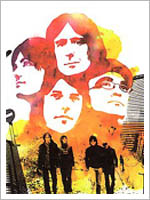
winnerys_music.jpgYet The Winnerys' competence at creating '60s pop mockups almost obscures the fact that the listener is essentially being lectured in Pidgin. I tend to notice the music first because I've had so much experience with the latter on public transit. And this Pidgin slides under the radar, because it's been buffed free of the halting and trepidation that usually accompany a speaker's second language. "No Longer White" paves over its own lyrics with Rubber Soul/Revolver-inspired cheer. In spirit, I guess, it's probably meant to resemble the Beatles' "And Your Bird Can Sing," a spiritual scolding that bubbles with George Harrison's giddy guitar hooks. Maybe Mr. Polo is telling us that he's ascended to a new plane of derivative hip by delivering a tirade without losing his pop-crafted cool. But ultimately I'm going to have to agree with the ever-sage Allmusic, which calls The Winnerys "the Castilian Rutles," a label that seems even more perfect once you've heard "My Daily Ray Of Sunshine:"

. . . You're my daily ray of sunshine
The daily ray of sunshine of my world


The trick is to tell yourself the tears are from laughter. Mine are. The chorus of the Beatles' "Good Day Sunshine" is shorter and somehow less dumb. Conciseness is key in English, Polo.

The Gurus seem to be the newer and more urban ones, and not just because their CD shows the band staring at a mysterious glow emanating from one member's crotch, and/or the center hole of the disc. The Gurus on this record can be found often mixing their best George Harrison impersonations with their best Beck impersonations, which I can sometimes enjoy without feeling like a twerp. And, unlike New Urban Times, it never makes me feel like I'm playing "name the Beatles song this song most resembles," aka "Pictionary in Hell." I wouldn't spend money on this album, but I will give the band the benefit of the doubt: They at least seem capable of evolving their sound, psychedelic dick jokes aside.

The Gurus' LP ends with a cover of "I Need You," one of the Kinks' many early throwaway singles. It's a song that was charming because it was so disposable; see Lola versus Powerman and the Moneygoround Part One for background, not to mention "Lola," the Kinks single that kicks every other Kinks single's ass straight to hell. But of course, while The Gurus are doing all this bald imitation, they've got to try and sound like cheeky musical anthropologists. And their bass player, at least, is trying to look like one: Scroll down to the bottom of this page to see the video for "Good Morning," in which he plays a Paul McCartney-favored "violin"-body bass and even tries to make some of those goofy faces Paul makes when trying to make eye contact with the audience.


But what's really going to screw both of these bands? Their label and publicists. Don't expect me to be surprised at anyone from Western Europe who has a fair command of English. Especially not after hearing better bands like Sweden's The Hives (who I guess are just as derivative, but they used it in the interest of pure, tongue-in-cheek fun, just mowing people the hell over instead of clumsily coaxing them into listening) and France's Phoenix. National and linguistic boundaries don't really help us explain or appreciate rock music, and if you think they do, you're no better than the jerk who wouldn't stop yelling "CAAA-NA-DAAA!" between songs at that New Pornographers show I went to last year.

The Clash said phony Beatlemania was biting the dust in 1979. Nearly 30 years later, it's still biting it. Maybe one of these days it will finally be dead.

Labels: , ,

Friday, June 16, 2006

Off The Rails: A Recent History Of CTA Screw-Ups

Beachwood Reporter, July 16 2006 Link

According to online records of the National Transportation Safety Board, last week's Blue Line derailment is the fifth Chicago Transit Authority accident since 2001 to prompt an NTSB investigation. NTSB investigator Kitty Higgins, at a press conference last week, vaguely credited the CTA with making improvements following past investigations. But it's not clear that the CTA is taking the initiative. These reports suggest that while the CTA has followed some of the NTSB's recommendations, it didn't make full use of NTSB findings - or, say, basic logic and intuition - to fix pervasive safety problems, like drivers' negligence. It took three accidents and two urgings by the NTSB, for example, for the CTA to "implement systematic procedures" to monitor drivers' compliance with speed limits and signal rules. Here are summaries of the accidents, as taken directly from NTSB reports. under that, a roundup of recent small fires on the O'Hare branch of the Blue Line.

* * *

"Within a 2-month period in 2001, the Chicago Transit Authority (CTA) experiences two similar rear-end collisions involving CTA rapid transit trains. Both accidents were preceded by the train operators' having failed to comply with operating rules designed to prevent similar collisions. the investigation of the two accidents highlighted deficiencies in the CTA management's approach to ensuring rules compliance among its operators." Report (PDF, 1 meg)


1. A northbound Blue Line train rear-ends another on its way to O'Hare.

When: 5:40 a.m. on Sunday, June 17, 2001

Narrative: "[The operator] said that as she left the subway portal [from the Belmont Ave. stop on the O'Hare branch of the Blue Line] and exited a right-hand curve, she saw a train stopped about 100 feet in front of her. She stated that she moved the control handle to brake position 3 and then pulled the brake cord, but the train did not stop . . . when she did depress the track brake, it was too late to stop the train. She estimated her sight distance at 100 feet and the impact speed as 10 mph."

Injuries: 21 minor.

The Driver: "After accruing an excessive number of safety violations in May 2001, she was required to participate in a corrective case interview, the last step in the CTA's disciplinary process before discharge."

Conclusions: "Had the operator . . . stopped and contacted the control center when the cab signals on her train did not activate and had the control center then followed existing...procedures, the accident would be been prevented."

"The Chicago Transit Authority's management process for identifying and addressing operators who do not meet safety performance standards was not effective in addressing the repeated problems that the operator in the June 17 accident was experiencing."

2. A Brown Line train rear ends a Purple Line train south of the Sedgwick stop.

When: 8:15 a.m. on Friday, August 31, 2001

Narrative: "[The driver] said he experienced two "blue light" alarms [which mean that another train train is close ahead] . . . The operator said he experienced several R6.4 stops [automatic or manual stops when another train is close ahead] . . . once he entered the combined Brown/Purple Line tracks at Clark Junction, he proceeded after R6.4 stops without waiting for the train ahead to clear and without contact the operations control center [as CTA rules require]. He stated that it was common practice for operators to proceed on an R6.4 without waiting or calling."

"[The operator] stated that he left Armitage Station . . . knowing that he was following a Purple Line train close ahead . . . after leaving Sedgwick and passing Division, he entered the Church Curve, where visibility is limited by [a] church building . . . At the south end of the curve, he said that he observed the taillights of a train stopped about 100 feet ahead . . . he moved the control handle [to brake] . . . but the train did not stop . . . Several witnesses on the train stated that they did not feel the brakes engage before impact. [The report goes on to say the other train was stopped north of the Chicago station, following the rules waiting for yet another train ahead to move.]"

Injuries: One serious; 117 minor.

The Driver: " . . . was referred for remedial training after passing a stop signal on October 23, 1998, in violation of CTA operating rules . . . After the June 17 . . . collision . . . "

Conclusions: "Had the operator . . . complied with the Chicago Transit Authority's operating rules and waited for his stop signal to clear before proceeding, the accident would have been prevented."

Irony 1: "The CTA, in response to an issue identified by the Safety Board's investigation [of the June crash], began delivering a mandatory 4-hour refresher course on cab signal rules, operation on sight, and emergency braking . . . [the] operator [in the August crash] had not yet had the training; he had been scheduled to take it on the Monday following the accident."

In a later report, the board recommended the CTA "Develop and implement systematic procedures for performing and documenting frequent management checks to ensure all operating personnel are complying with Chicago Transit Authority operating rules, including speed restrictions and signal rules."

The NTSB would note after a 2004 accident that the CTA had still not responded to this recommendation.

Irony 2: In its report on the 2001 back-to-back rear-enders, the NTSB noted the disadvantages of not having "black box" event recorders on the trains. The train in last week's Blue Line accident did not have an event recorder, and it's not clear how many, if any, CTA trains do.

***

3. A Green Line train hits two workers on the Loop tracks. (Summary page)

When: 4:50 a.m. on Tuesday, February 26, 2002.

Narrative: "On the morning of the accident, two night-shift signal maintainers were repairing a switch at tower 18 . . . A trainee was operating the train, and a train operator/line instructor 2 was observing. Both crewmembers on the train later stated that they had not heard the control center's radioed advisory that workers were on the track structure . . . Both maintainers later stated that they had not seen or heard the train as it approached. After being struck, one of the maintainers fell from the structure. The other fell to the deck of a platform on the outside of the structure."

Injuries: Both maintenance workers were seriously injured. One was treated and released at a local hospital; the other had to stay for further treatment.

The Driver: A trainee, apparently not at fault.

Conclusions: "The probable cause of the accident was the failure of the signal maintainers to watch for approaching trains and their failure to obey the Chicago Transit Authority's requirement that they increase their visibility by displaying a flashing yellow warning light. Contributing to the maintainers' reduced awareness of oncoming trains was the absence of clear requirements regarding the designation of safety lookouts and the use of interlocking signals to protect work areas."

"The CTA did not have any written rules providing for interlocking signals to be used to protect workers on the wayside . . . the CTA did not have any written procedures requiring that a safety lookout be designated."

Results: "The CTA told National Transportation Safety Board investigators that it has implemented new procedures that require the conducting of pre-entry safety discussions among crewmembers before they foul the right-of-way and the designating of a safety lookout. The CTA has also begun an ongoing program of management right-of-way field safety rules compliance audits and is in the process of evaluating the use of interlocking equipment to establish areas of worker protection. While the evaluation is underway, the CTA is requiring crews to make face-to-face contact with the tower operator before commencing work in an interlocking."

4. A northbound Purple Line train rear-ends a Brown Line train just north of Merchandise Mart. (Summary page)

When: 5:46 p.m. on February 3, 2004

Narrative: "The motorman of [the Purple Line train] told investigators that as he operated the train northward, he diverted his attention to the street below and was distracted by what he believed was going to be a vehicle accident. The motorman stated that when he looked away from the street and toward his direction of travel, his train was about 10 feet from the rear of the stopped train. He said he immediately applied the emergency brakes, but it was too late to stop his train, and the train collided with the rear car of the stopped train . . . The rear marker lights of the stopped train were illuminated and that the rear car had about 138 feet of preview."

Additional Hazard: "The fiberglass walkway grating between the accident trains and the MART platform was covered in ice and jeopardized the safe evacuation of the passengers."

Injuries: 42 minor.

The Driver: Had already worked an overnight shift and overtime as a switchman, then, after a 3 1/2 hour nap, volunteered to work the driving shift.

Conclusions: "The the probable cause of the accident was the failure of the operator of [the Purple Line train] to comply with operating rules. Contributing to the accident was inadequate operational safety oversight by Chicago Transit Authority."

Results: "[In an earlier investigation in Maryland,] the Safety Board . . . asked rail transit systems to "ensure that your fatigue educational awareness program includes the risks posed by sleeping disorders, the indicators and symptoms of such disorders, and the available means of detecting and treating them." The CTA senior manager, System Safety and Environmental Affairs, told investigators that the CTA is addressing [the recommendation] and is also evaluating other conditions that may cause fatigue."

***

Recent small fires on the CTA Blue Line, O'Hare Branch.

1. Sunday, June 13, 2004: A fire breaks out on the third rail between the Logan Square and Belmont Blue Line stations; seven people injured, according to the Sun-Times (third item).

2. August 8, 2003: A small fire, attributed to sparks from the third rail, breaks out in a Blue Line tunnel between Division Street and Chicago Avenue; about 30 minor injuries reported; ABC 7 reports that "a CTA official says the operator should not have evacuated the passengers into the dark subway for the small fire."

3. June 13, 1997: Yet another Blue Line fire in the Milwaukee Avenue tunnel; again, blamed on electrical problems in the third rail; five are treated for smoke inhalation.


Labels: , , , , ,

Friday, June 02, 2006

Blogging For Freedom

Beachwood Reporter, July 2 2006 Link

When the news broke in May that the National Security Agency had created a huge database of Americans' phone records, incensed portions of the blogosphere cranked up their message machines, demanding that something be done.

But what?

Daily Kos blogger Da Buddy had an idea. In an "ACTION ITEM" posted on Kos, Da Buddy urged readers to "bombard" the NSA with Freedom of Information Act requests asking for records involving their own phone numbers. "And they HAVE to respond within 20 days, by law!" Da Buddy assured confidently.

Not a bad idea, but a rather unknowing one. Da Buddy's mob could indeed expect a response within 20 days - most likely a letter from the NSA explaining why the agency would need more than 20 days to respond to their requests.

The Freedom of Information Act is a jewel of democracy, but an imperfect one. The NSA's own FOIA policy (pdf), for example, states that "In the event the Director of Policy cannot respond within 20 working days due to unusual circumstances, the chief of the FOIA office shall advise the requester of the reason for the delay and negotiate a completion date with the requester."

So good luck with that.

Freedom geeks are not only celebrating Independence Day this week, but the the 40th anniversary of the Freedom of Information Act. That makes it a particularly good time to consider FOIA's many loopholes as well as the opportunity presented by the growing swarm of bloggers and citizen journalists to press for fixes both federally and, perhaps more importantly, in state FOIA counterparts. Because one thing we've clearly learned in the last 40 years is that the use of the Freedom of Information Act is neither free nor always informative.

As anyone who's ever FOIAed a government agency in Chicago, greater Cook County, or the State of Illinois knows, there's almost no way to force an agency to give you what you're entitled to, much less in a timely manner at reasonable fees, particularly if you are a little guy without, say, the lawyers of the Tribune Company backing you up.

Even if you can get the records you are looking for, you may be discouraged by the cost you will incur. It's not uncommon for agencies around here to charge a quarter a page for copies of FOIAed records. If you're doing serious research on a regular basis, this adds up quickly. An Evanston clerk I dealt with recently (on a non-Beachwood matter) rationalized their quarter-per-page price this way: The person who gathered the records for me could have been doing something else with that time.

The clerk assured me that Evanston's Law Department made sure everything was legal before setting the copy price, but the policy clearly violates the Illinois FOIA statute provision that "Each public body may charge fees reasonably calculated to reimburse its actual cost for reproducing and certifying public records and for the use, by any person, of the equipment of the public body to copy records. Such fees shall exclude the costs of any search for and review of the record, and shall not exceed the actual cost of reproduction and certification, unless otherwise provided by State statute."

The state's Public Access Counselor, Terry Mutchler, agreed and sent the city a letter, but otherwise I've got no recourse, because neither she nor I have the time or money to go to court.

In all its mundanity, my experience with Evanston city government is just a sliver of battles frustrating citizens on a daily basis across Illinois, and often with much larger stakes than my own. It is also antithetical to the spirit of the Freedom of Information laws designed to undergird our democracy.

That's where electromob action comes in. Da Buddy is actually onto something. Bloggers are better positioned than any other group of concerned citizens to throw their political heft - and conspicuous tonnage of spare time - behind Freedom of Information. Aside from the obvious - FOIAing the crap out of as many agencies as possible - I propose focusing on four main goals:

1. Investigative and punitive provisions in FOIA law. Public officials who deny access through deliberate obfuscation and delay should be charged with felonies - and if they are trained as lawyers, disbarred. After all, shouldn't conducting government in secret be considered treasonous?

2. Training requirements for all government employees who handle public records. In Illinois, the seeds are in place.

3. More and better searchable online databases of government documents, which can circumvent much of the cost and hassle of digging up and copying records in the first place. Some government agencies - hello, Cook County Circuit Court - are still unaware of what the Internet can do for them. After all, searchable records free up clerks like the ones in Evanston to attend to the rest of their pressing duties, while shifting copying costs to the folks at home. The investment cost of digitizing records - well - will have to borne sooner or later. Why not now?

4. Strengthening state FOIA laws. Reporters who have spent time in other states - Florida, for example - are amazed at what isn't available in Illinois. (Illinois was the last state to pass an open records law, and it's not exactly a thing of beauty, Scott Reeder's astonishing success notwithstanding.) The impact is as much cultural as anything; the expectations of Chicago reporters are often so low it's easy to think they deserve what they don't get. Citizens deserve more, though.

If the institutional media isn't interested in the consistent, aggressive use of public records, and there is no indication they are, perhaps bloggers across the political spectrum can fill the void.

The Sunlight Foundation has just shown what bloggers and other regular folk can do for Illinois. On June 14, foundation reporter Bill Allison revealed that our very own Dennis Hastert owns 138 acres of land near the route of the Prairie Parkway, a proposed road that would run between I-80 in Grundy County and I-88 in Kendall County. Allison wrote that Hastert has "secured $207 million in earmarked appropriations" for the project. Note that this break came not through state or local records from Illinois, but federal documents - Hastert's 2005 financial disclosure form.

The Sunlight Foundation's welcome Assignment Desk is meant to empower citizen journalists to do their own digging through public records. Chicago is sorely lacking in blogs that dig into our hulking, opaque institutions, but some sites seem to have laid the groundwork. At the CTA Tattler, for example, editor Kevin O'Neil has managed to attract the "CTA Insider" - an anonymous CTA employee who provides biting commentary on everything from seat cushions to Pink Line jam-ups. Now imagine what the CTA Tattler could do if it introduced public records pursued through FOIA into its work.

Perhaps the notorious drag of obtaining documents from the government would trip up the immediacy that so invigorates bloggers. But at some point blogs have to evolve - and that means the addition of reporting, with public records perhaps the ripest tool.

(In her New Republic cover story about InstaPundit Glenn Reynolds, Christine Rosen summed up the stagnation of most political blogs: "Reynolds's blog consists largely of links to news or opinion articles and other blogs followed by comments consisting of such profound observations as 'Heh,' or 'Read the whole thing,' or 'Indeed.' (These are recurring tropes whose centrality can't be exaggerated.) What Reynolds lacks in analysis, he makes up for in abundance of content. On any given day, he'll provide his readers nearly 20 entries - or, if you can stomach it, more.")

And as shown by Pajamas Media's now-dormant IraqFiles in which Iraqis, a military expert, and others sifted through captured Iraqi documents, blogs can connect people who are willing to volunteer expertise and knowledge that's actually revealing.

"One of the things I hate about a lot of political blogs is that they choose really stupid things to write about," Thad Anderson, of Outraged Moderates and Download for Democracy, said recently. " Some people don't really understand my point of view, in that they don't put the same value I do in seeing the actual documents myself. But I think that, in an era of distrust and cynicism, focusing on the documents themselves is especially effective."

Labels: , ,